Chief Justice Salmon P. Chase died on this day in 1873. As we noted in our Closer Look on his life and career, Chase was a passionate abolitionist and was once praised by President Abraham Lincoln as being “about one and a half times bigger than any other man that I ever knew.” (He is also the namesake of our executive editor’s second child.)
And as we explained on Tuesday, Justice Clarence Thomas, as of today, is the second-longest-serving Supreme Court justice in history.
At the Court
On Wednesday, the court denied a motion to recall its opinion in Louisiana v. Callais. The motion was filed after the court agreed to immediately finalize its opinion, which gives Louisiana more time to draw a new congressional map before the 2026 elections.
Also on Wednesday, Justice Elena Kagan denied Apple’s request for the court to pause a civil contempt order entered against it by a lower court. For more on the dispute, see the On Site section below.
In response to requests from Danco Laboratories and GenBioPro, Justice Samuel Alito temporarily paused a ruling by the U.S. Court of Appeals for the 5th Circuit that reinstated the requirement that the abortion pill mifepristone be dispensed only in person. Responses to the companies’ requests are due today by 5 p.m. EDT.
The court has indicated that it may release opinions on Thursday, May 14, at 10 a.m. EDT. We will be live blogging that morning beginning at 9:30.
Morning Reads
DOJ Plans Intervention in Trump Supreme Court Carroll Appeal
Erik Larson, Bloomberg (paywalled)
The Justice Department “will ask the Supreme Court to let it intervene in President Donald Trump’s appeal of the $83.3 million jury verdict against him in a defamation suit brought by former Elle magazine advice columnist E. Jean Carroll,” which centers on comments Trump made about Carroll after she accused him of sexual assault, according to Bloomberg. “The government will ask the high court justices to substitute the US for Trump in the case because the president was acting as a government employee when he denied Carroll’s sexual-assault claims in 2019.” Bloomberg noted that “[s]ubstituting the US for Trump – allowed under the Westfall Act of 1988 – would result in the suit being dismissed because the US can’t be sued for defamation. A panel of appeals court judges previously denied the government’s request to invoke the Westfall Act in the case.”
How Trump’s immigration crackdown is affecting everyday Americans, according to a new AP-NORC poll
Linley Sanders, Tim Sullivan, and Mike Catalini, Associated Press
A new survey from the Associated Press-NORC Center for Public Affairs Research explored Americans’ views on “Trump’s immigration crackdown.” Among other findings, the poll showed that most U.S. adults support birthright citizenship, the future of which is currently before the Supreme Court. “About two-thirds of U.S. adults in the poll say automatic citizenship should be granted to all children born in the country, a view that most Democrats and independents back. Republicans are more doubtful: just 44% support birthright citizenship.” However, the poll found that respondents’ opinions changed slightly when presented with more information. “[A]bout 6 in 10 U.S. adults say they support birthright citizenship for children born to parents on legal U.S. tourist visas, while only about half support it for those born to parents who are in the country illegally. An even higher share, 75%, support automatic citizenship for children born in the U.S. to parents who are in the country legally on work visas, with much of that increased support coming from Republicans saying this was an acceptable situation.”
Appeals court split on ICE’s mandatory detention policy
Kyle Cheney, Politico
A divided panel of the U.S. Court of Appeals for the 7th Circuit ruled on Tuesday that the Trump administration cannot “lock up the majority of people it is seeking to deport, without an opportunity for release on bond,” according to Politico. “The opinion’s author, Judge John Lee, a Biden appointee, emphasized that no prior administration believed there was a mass detention mandate in the 1996 law that Trump administration officials have claimed justifies their new policy. And despite the complexities and complicated language of the law, it’s simply implausible that Congress passed a sweeping detention mandate 30 years ago without anyone noticing, the court said.” Politico noted that Tuesday’s “ruling exacerbates a division among courts that could supercharge the issue’s path to the Supreme Court. Though federal district court judges have overwhelmingly rejected the Trump administration’s approach, federal appeals courts are split.”
Second Batch of Documents from State Department Describe Additional SCOTUS Travels Abroad
Fix the Court
Fix the Court on Wednesday shared takeaways from the second batch of documents it received from the State Department as a result of a Freedom of Information Act lawsuit. The documents addressed Justice Sonia Sotomayor’s 2023 “trip around the Greek Isles on a rented 129’ superyacht named the White Knight,” which she paid for herself and was therefore “not required to include … on her financial disclosure” for that year. Fix the Court explored potential security concerns raised by this and other international trips, noting that Supreme Court security personnel appeared to communicate with the State Department about carrying weapons in other countries (the actual word used, which was likely “firearm,” was redacted), and observed that officials also worked to ensure that the justices would have access to top hospitals and health care in other countries.
DOJ challenges Denver’s assault rifle restrictions
Amanda Pampuro, Courthouse News Service
On Tuesday, the Justice Department filed a federal lawsuit “challenging Denver’s 37-year-old assault rifle ban,” arguing that it violates “citizens’ Second Amendment rights.” “The federal government points to two landmark U.S. Supreme Court cases: 2008’s District of Columbia v. Heller – protecting law-abiding citizens’ right to possess lawful weapons – and 2022’s New York State Rifle & Pistol Association v. Bruen, which directs courts to compare modern gun restrictions with historical firearm regulation,” according to Courthouse News Service. The government contended that “the firearms the city calls ‘assault weapons’ include ordinary semiautomatic rifles possessed by millions of law-abiding Americans.”
On Site
Interim Docket
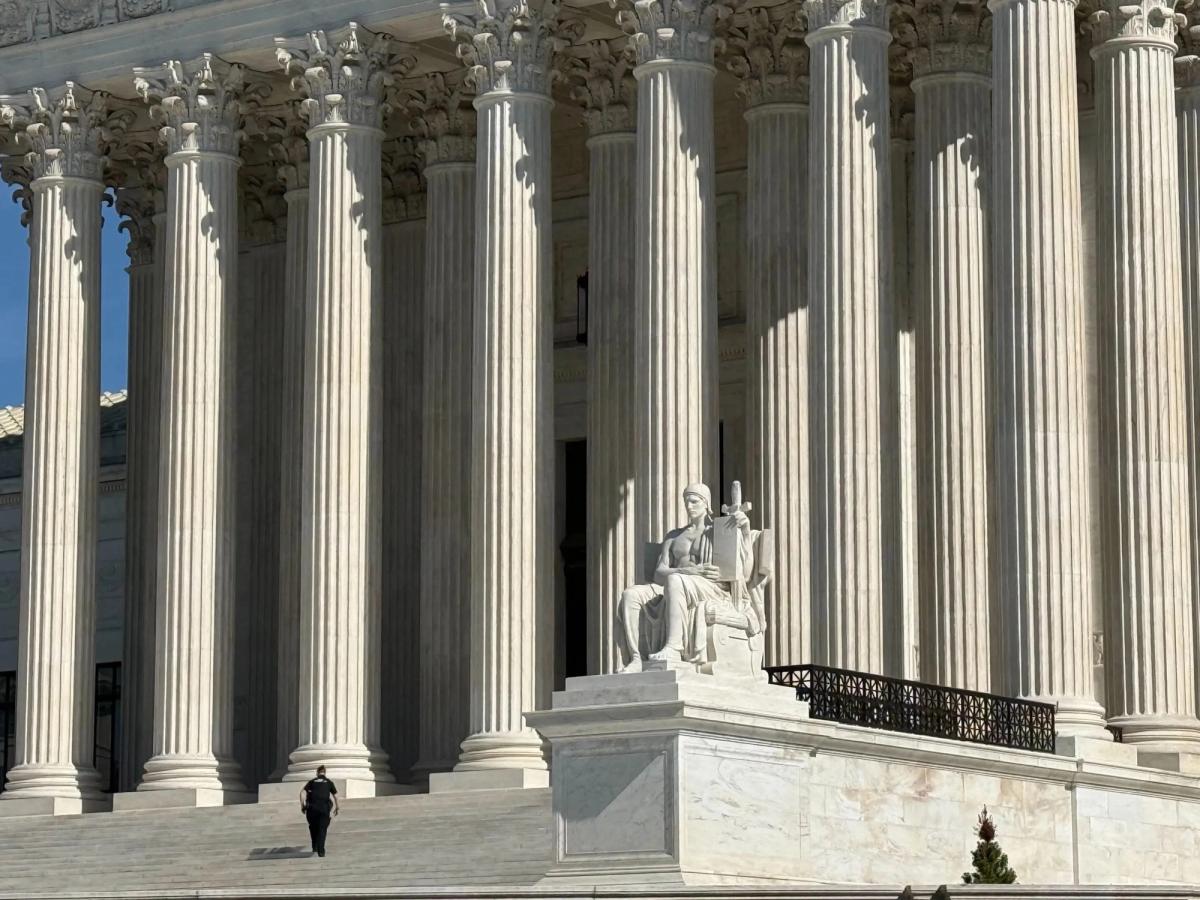
Court turns down Apple’s request to pause order holding it in contempt
Justice Elena Kagan on Wednesday morning turned down a request from tech giant Apple to intervene in the latest chapter of its long-running dispute with Epic Games, the maker of the popular videogame Fortnite. The timing of Kagan’s response – and the fact that it came from her rather than the full court – suggest that it was not a close call.
Contributor Corner
A 2-3-4 wild card court; and Blanche v. Lau made easy
In his ScotusCrim column, Rory Little explained why he sees the current Supreme Court as a “wild card court” comprised of three distinct units: Justices Samuel Alito and Clarence Thomas, a “conservative” two-justice bloc; Justices Elena Kagan, Sonia Sotomayor, and Ketanji Brown Jackson, a “liberal” three-justice bloc; and the remaining four, who are in the middle. He also revisited Blanche v. Lau, a case on the rights of lawful permanent residents, suggesting “a narrow and simple solution.”
Contributor Corner
The recent Voting Rights Act case
In his Courtly Observations column, Erwin Chemerinsky explained the court’s path to Louisiana v. Callais. The decision and its impact, according to Chemerinsky, “must be understood as the product of five prior decisions by the court in the area of voting rights, all split along ideological lines: City of Mobile v. Bolden, Shaw v. Reno, Shelby County v. Holder, Rucho v. Common Cause, and Alexander v. South Carolina State Conference of NAACP.”
Podcasts
Amarica’s Constitution
Fourteen Colonies, Ten Commandments
As the Ten Commandments case makes its way towards the Supreme Court, Akhil Amar and Andy Lipka add another chapter to their study of the historical events and factors that went into the American constitutional tradition when it comes to religious freedom, religious establishment, and the relationship of government and religion as a whole.
A Closer Look
Hedgepeth v. Britton
At their next private conference on Thursday, May 14, the justices are expected to address a petition for review involving Facebook posts on Black Lives Matter protests, a community uproar, and competing claims about public school teachers’ free speech rights.
The case, Hedgepeth v. Britton, centers on Jeanne Hedgepeth, who, until 2020, was a social studies teacher at Palatine High School in Illinois. Hedgepeth was fired over Facebook posts she made on May 31 and June 1, 2020, while on vacation in Florida, which referenced protests over George Floyd’s death in police custody.
According to the petition, Hedgepeth shared “pictures of her beachfront view with the caption: ‘I don’t want to go home tomorrow. Now that the civil war has begun I want to move.’” When a Facebook friend commented that she should move, Hedgepeth replied, “I need a gun and training.” Hedgepeth also “reposted a satirical meme that read, ‘Wanna stop the [r]iots? Mobilize the septic tank trucks, put a pressure cannon on em … hose em down … the end.’ Hedgepeth added: ‘You think this would work?’” During this period, she also exchanged a series of Facebook comments with a former Palatine student about racism, abortion, and the concept of white privilege.
Hedgepeth’s Facebook was set to private, but her posts and comments quickly spread through the Palatine community. Students, teachers, parents, alumni, and news organizations reached out to the school about Hedgepeth, prompting the school district to release a statement “clarifying that Hedgepeth’s posts ‘do not reflect the values or principles of District 211’ and apologizing ‘for any harm or disrespect that this may have caused,’” according to the U.S. Court of Appeals for the 7th Circuit. In June 2020, school leaders informed Hedgepeth that they would recommend to the school board that she be fired, citing the Facebook posts and “Hedgepeth’s prior disciplinary sanctions and warnings,” including for using profanity in her class. After weighing the issue at two consecutive meetings, the board voted for Hedgepeth to be dismissed.
Hedgepeth asked the Illinois State Board of Education to review the board’s decision and also filed a federal lawsuit against the board and board members who voted in favor of her termination. She alleged that her firing violated the First Amendment’s free speech protections.
In February 2024, a federal district court in Illinois sided with the school board, and the 7th Circuit affirmed that decision last August. First, the 7th Circuit considered whether Hedgepeth’s Facebook posts were a form of protected speech, determining that they were because she was speaking “as a citizen on a matter of public concern.” Then, it considered whether Hedgepeth’s interest in sharing that speech outweighed “the District’s interest in addressing actual disruptions and averting future disruption,” applying the balancing test that was outlined by the Supreme Court in 1968’s Pickering v. Board of Education. The court concluded that “the District’s interest in workplace efficiency outweigh[ed] [Hedgepeth’s] right to speak.”
Hedgepeth has now asked the Supreme Court to review whether the 7th Circuit properly balanced the school district’s interests against her own. According to the petition for review, the lower court, in applying Pickering’s balancing test, should have focused on what, if any, specific impact Hedgepeth’s Facebook posts had on instructional and extracurricular activities at the school, rather than on the general disruption they may have caused in the community. “Whatever latitude public employers may have to restrict speech to avoid genuine workplace disruption, it does not extend to firing employees for engaging in private, off-duty speech simply because school officials must field some complaints from people” who may live near the school but who are not current “students, parents, or faculty,” the petition says.
Initially, the school board and board members named in the lawsuit waived their right to respond to Hedgepeth’s petition for review, but the court requested a response in February. In that response, filed last month, the board emphasized Hedgepeth’s two past suspensions “for profane outbursts at students,” presenting her termination as the culmination of multiple violations of district standards, rather than as a response to only the 2020 Facebook posts. The board further argued, in any event, that the 7th Circuit had properly balanced Hedgepeth’s free speech rights against the school district’s interests as an employer, contending that Supreme Court precedent does not prevent courts from assessing the broader community’s – and not just teachers’ and students’ – response to challenged speech in the process of determining “whether the speech affected the government entity’s ability to provide effective and efficient public services.”
Hedgepeth v. Britton is scheduled to be considered by the justices for the first time at their private conference on Thursday, May 14.
SCOTUS Quote
“The peculiar circumstances of the moment may render a measure more or less wise, but cannot render it more or less constitutional.”
— Chief Justice John Marshall (1819)