In the Interim is a recurring series by Taraleigh Davis on the Supreme Court’s emergency docket, using data to help explain how it works.
Jodi Kantor and Adam Liptak of the New York Times recently obtained and published the internal memos behind the Supreme Court’s February 2016 order staying President Barack Obama’s Clean Power Plan, the signature environmental policy of his administration. The reporting is significant: this was the first time on the emergency docket that the Supreme Court halted such a major executive regulatory action before an appellate court ruled on it. And the leaked memos offer a rare look at the justices’ private deliberations in doing so.
As someone who has spent considerable time examining the emergency docket, I want to offer some additional context about what the memos show and what they don’t. The New York Times is correct that the court’s ruling – to halt such a pivotal executive action on its emergency docket – was something new. But the emergency docket was long in effect – and the nature of the court’s deliberations on it were hardly unprecedented.
What was actually new in 2016
In October 2015, the EPA finalized the Clean Power Plan, the first federal rule to limit carbon emissions from existing power plants. These were the country’s single largest source of carbon emissions, and the rule was the centerpiece of the Obama administration’s climate agenda. It required states to cut power-sector carbon emissions 32% below 2005 levels by 2030. The Senate had voted twice to kill the rule.
Upon its implementation, 27 states and industry groups immediately challenged the rule in the U.S. Court of Appeals for the D.C. Circuit and asked that court to block it from taking effect while the case was litigated. The D.C. Circuit denied the stay on Jan. 21, 2016. The applicants then turned to the Supreme Court and asked the justices to halt the rule while the D.C. Circuit was still considering the case. On Feb. 9, 2016, by a 5-4 vote, the Supreme Court granted the stay.
The New York Times piece frames this as the moment the court took a wrong turn. In their telling, the justices “bypassed time-tested procedures and opted for a new way of doing business.” The Times treats nearly everything about the 2016 decision as a break from the court’s prior operation: the speed, the secrecy, the lack of a written opinion, the partisan 5-4 split, and the court acting in advance of any appellate court ruling.
The Times is wrong about most of this.
What the Times got right
There was a new aspect of things, and it was significant: nobody had previously asked the court to halt such a major executive regulatory action before any appellate court had ruled on it. And, accordingly, the court had never agreed to do so. West Virginia’s own solicitor general, Elbert Lin, put it plainly in an interview with the Times: “This had never been done.” And as Justice Elena Kagan noted in her memo, it would have been unprecedented for the court to second-guess the D.C. Circuit’s decision that a stay was not warranted without the benefit of a prior judicial decision. That is all accurate: Going back through my dataset of emergency applications to 2000, the court had not granted or denied a stay pending consideration of a major executive regulatory action in that specific posture. In that way, and in that way alone, this was a striking development of the court’s modern emergency docket.
But the deliberative process is not new
Although Kantor and Liptak are thus correct that the nature of what the court was being asked to do was different, they further describe the memos as “nothing like the court’s usual painstaking work.” In support of this claim, they refer to the order being justified in the memos by a blog post and a television interview; point to the justices’ using their first names to refer to one another; and describe expressions of irritation between the justices.
None of those things were novel. Rather, the justices responded deliberately, over five days, through exactly the kind of collegial back and forth that has characterized the emergency docket deliberations for decades.
In February 2026, I examined Justice John Paul Stevens’ papers at the Library of Congress, including his files on emergency applications. What I found was the same process the New York Times describes in 2016. The circuit justice wrote a detailed memo laying out the facts and a recommendation, colleagues responded with their own memos, and votes sometimes changed before the final order issued.
Of the factors Kantor and Liptak cite, none of these were unusual either. First, the justices cited outside sources in their memos. In the 2002 emergency application in Forrester v. New Jersey Democratic Party, for example, which asked the court to block the substitution of candidates on the New Jersey Senate ballot, Stevens circulated a memo to the conference that quoted at length from a New York Times article on the New Jersey ballot fight as evidence that “it is well recognized in New Jersey that strict compliance with election deadlines is not required when there is no significant impingement on the election process.”
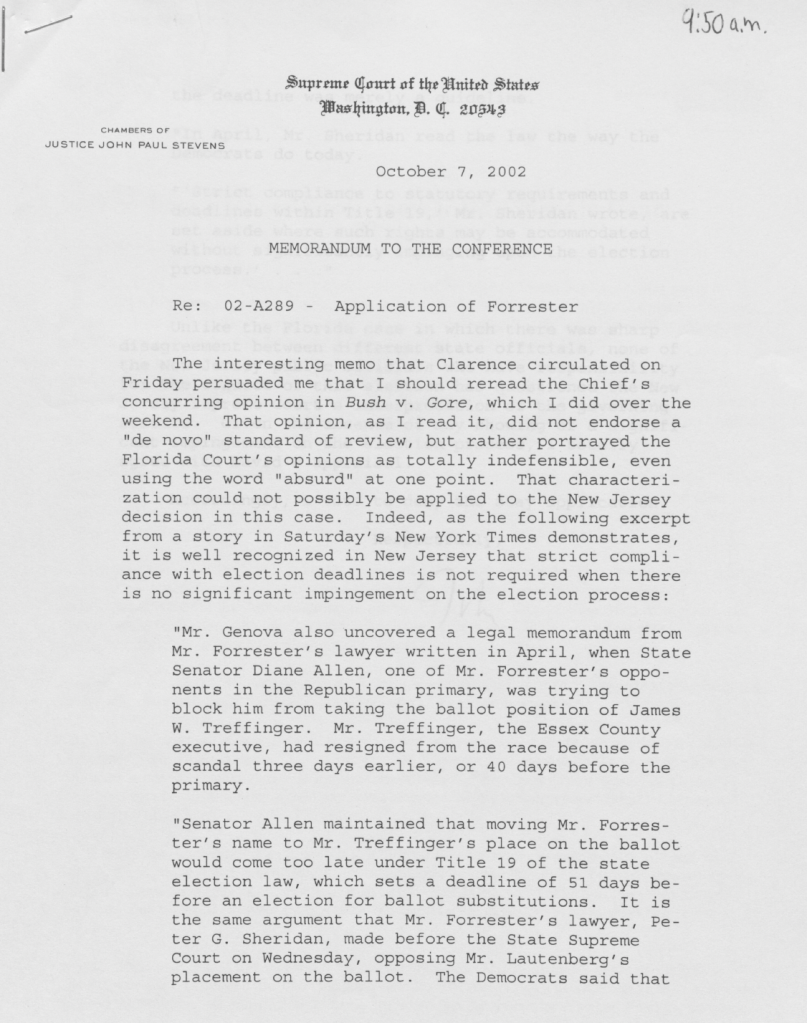
(II:881, John Paul Stevens Papers, Manuscript Division, Library of Congress, Washington, D.C.)
A review of the Stevens’ papers also shows that justices signing their first names was entirely standard practice across decades of emergency docket deliberations. Justice Sandra Day O’Connor signed “Sandra,” Justice Antonin Scalia signed “Nino,” and Justice Ruth Bader Ginsburg signed “Ruth.”
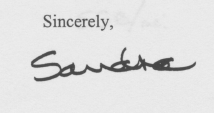


(II:833, John Paul Stevens Papers, Manuscript Division, Library of Congress, Washington, D.C.)
A first name signature may simply indicate that the justice signed the memo personally rather than having a clerk do so.
Finally, and of seeming greater importance, the New York Times emphasizes as unusual the justices’ tones throughout their memos. Specifically, Kantor and Liptak describe the chief justice circulating “a blast of a memo,” characterize him as acting like a “bulldozer,” and suggest that he “sound[ed] irritated” by Breyer’s proposed alternative order, which would have denied the stay but allowed the applicants to return to the court if circumstances changed. The article claims that Roberts’ arguments for halting the president’s executive action were “forceful, quick, and filled with confident predictions,” and that he “weighed no potential downsides of his proposal and considered no alternatives.”
But, again, the justices handled this case the way they handled prior ones on the emergency docket. In Moore v. Texas, a 2002 capital case in which Curtis Moore sought a stay of execution pending the court’s decision in Atkins v. Virginia, Justice Antonin Scalia wrote to his colleagues that “John” (Justice Stevens) “greatly overstate[d]” the evidence of Moore’s intellectual disability, that “[Stevens’] theory is mistaken,” and that Stevens’ reading was “surely not the law.” That is considerably more pointed and personal than anything Roberts wrote in his memos.
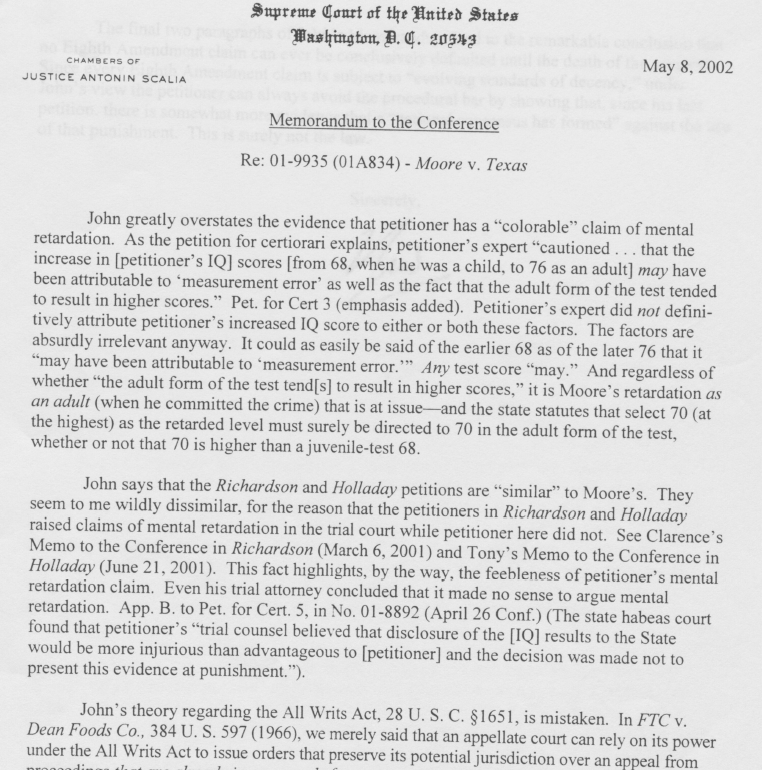
(II:859, John Paul Stevens Papers, Manuscript Division, Library of Congress, Washington, D.C.)
Perhaps most significantly, the legal standards invoked in 2016 were no different than in years past. On the emergency docket, the circuit justice always writes the initial memo, lays out the facts, and applies the four-factor framework on granting a stay: whether there is a reasonable probability of cert, a fair prospect of reversal, the prospect an applicant will suffer irreparable harm, and a balancing of the equities. Roberts did exactly that.
Reading Roberts’ memos without that context might make the EPA case seem like an outlier. But, in that regard, it most certainly was not.
So what was different?
What is likely driving the reaction to Roberts’ memo is not its tone but its substance and the outcome. As described earlier, the stay stopped Obama’s signature environmental policy. In the memo, Roberts argued irreparable harm on behalf of the coal industry, citing cost estimates as high as $480 billion and warning that compliance with a regulation later found unlawful would be irreversible. That analysis looks very different in the current moment, when the same framework has been applied in ways that increasingly favor executive actions by President Donald Trump.
The question of whether irreparable harm is being assessed consistently, regardless of who is asking and what they are asking for, is a legitimate and important one. But that is a conversation about how the legal standards have been applied over time, not about whether the chief justice was a “bulldozer” in these memos.
Lastly, the New York Times acknowledges that “it is not known whether the other members of the conservative wing, Justices Antonin Scalia and Clarence Thomas, prepared memos. Likewise, it is not known whether the court’s fourth liberal, Justice Ruth Bader Ginsburg, circulated her own memo.” That acknowledgment deserves more attention than it receives in the piece.
In every case I examined in the Stevens’ papers, every participating justice circulated a memo, even if just a single sentence: “I vote to grant the stay.”
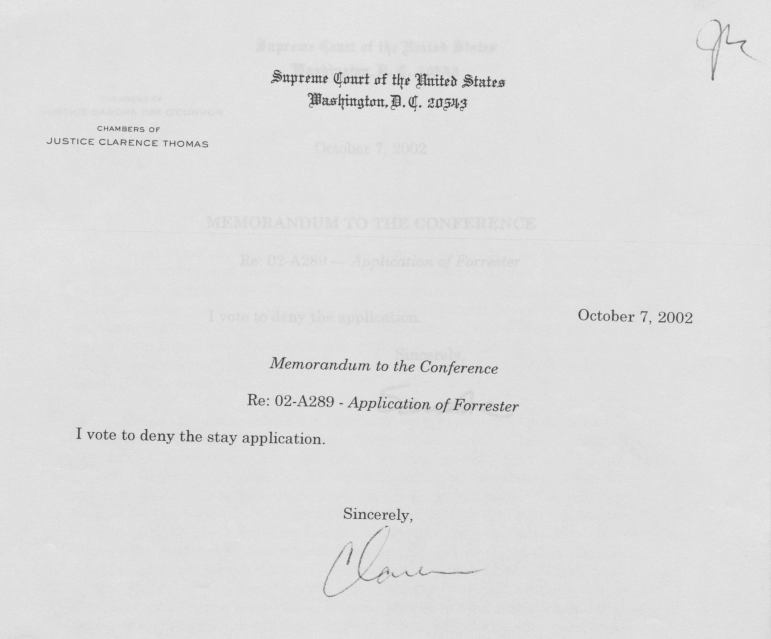
(II:881, John Paul Stevens Papers, Manuscript Division, Library of Congress, Washington, D.C.)
Given this, what the New York Times has published is not a complete record, and conclusions about the tenor, balance, or reasoning of the full conference remain partial.
In other words, none of this answers the ultimate question: why did the justices grant relief in this unprecedented posture? The New York Times frames this narrative as a clash between Roberts and Obama, or as between the chief justice’s institutional instinct to rein in executive action and a president who had promised to act with or without Congress. It is a compelling story, but the memos themselves cannot carry it. Whatever you think of the outcome, they do not show a court plucking a result out of the air. They show justices citing precedent, applying the four-factor framework, and debating whether to wait for the D.C. Circuit to act. Of course, one can disagree with the precedents the justices invoked or with how they applied them. But the deeper question, why the court granted the ask and why at that moment, the memos do not resolve.
What the memos actually show
The New York Times casts the 2016 stay as the origin point of the modern emergency docket, the moment the justices “bypassed time-tested procedures and opted for a new way of doing business.” That framing is too simplistic. The procedures were not bypassed: the memos, the back-and-forth, the circuit justice recommendations, the confident predictions, the engagement with colleagues by name – this had long predated February 2016.
What was genuinely new was the question the court was asked to answer: whether to halt a sweeping federal regulatory program before any appellate court had reviewed it. And, admittedly, the court’s answer mattered. The justices could have denied the application and waited for the D.C. Circuit to rule. By doing otherwise, they established that this kind of relief was available, and litigants have been asking for it ever since. That is a significant development in the emergency docket’s history. But the court did not stumble into it. It deliberated carefully, in exactly the way it always had.
The post What the New York Times got wrong – and right – about the emergency docket appeared first on SCOTUSblog.